

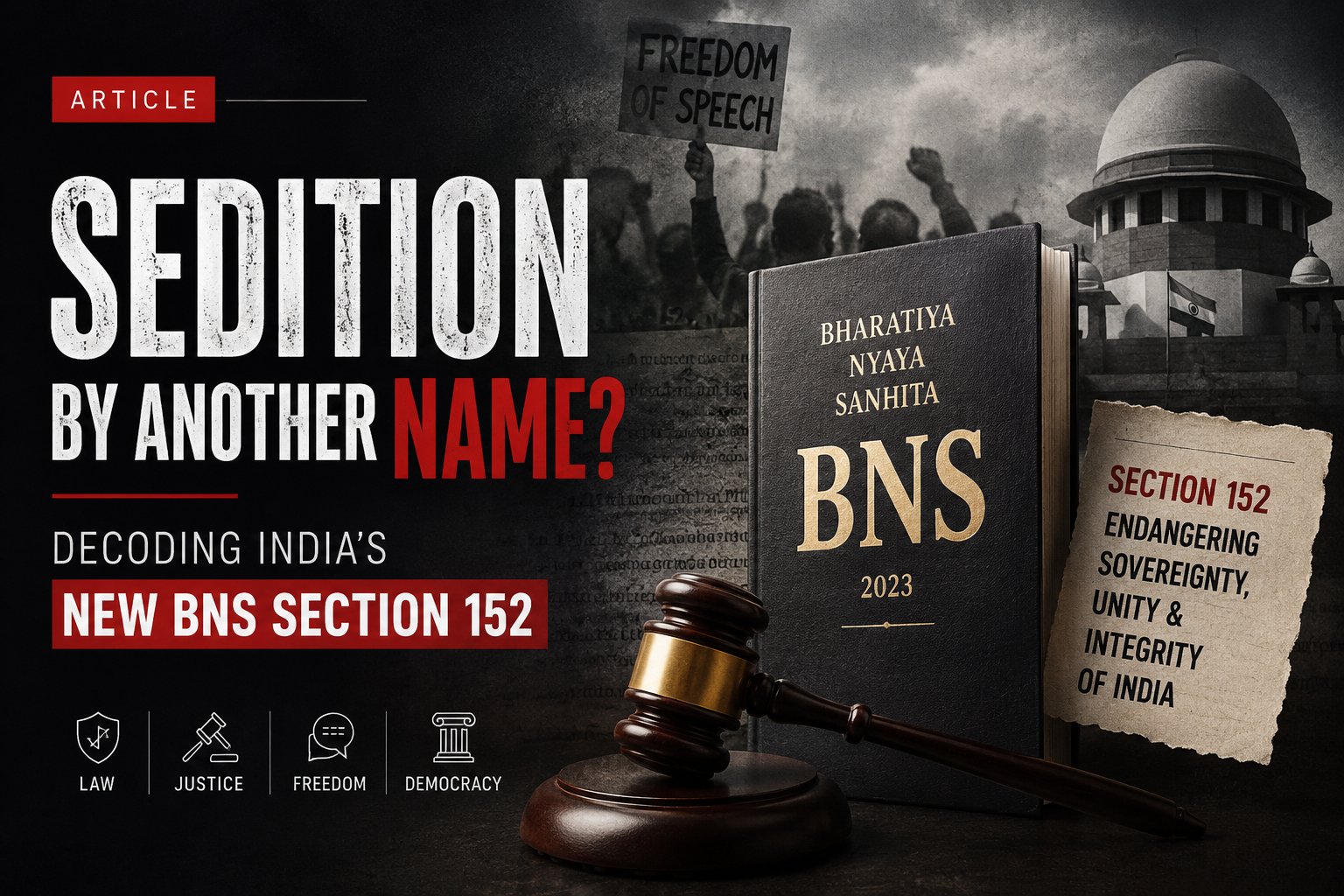
India’s criminal justice system recently got a massive makeover. The colonial-era Indian Penal Code (IPC) of 1860 has been officially replaced by the Bharatiya Nyaya Sanhita, 2023 (BNS). Propounded as a major step toward decolonizing our laws, one of the most talked-about updates is the supposed removal of the controversial “sedition” law.
But before we celebrate the end of this historically oppressive law, we need to ask a critical question: Did sedition actually disappear, or did it just get a modern rebrand?
The Ghost of IPC Section 124A
To understand where we are, we have to look at where we came from. Section 124A of the IPC was not originally part of the penal code; it was introduced by the British in 1870 to crush nationalist sentiments. It penalized anyone who brought hatred or contempt or excited disaffection against the government.
This sweeping language made it the perfect weapon against freedom fighters.
- Bal Gangadhar Tilak was convicted under it for his speeches and writings.
- Mahatma Gandhi was charged for writing critical articles, famously calling Section 124A “the prince among the political sections of the IPC designed to suppress liberty”.
After independence, the Supreme Court stepped in to stop its misuse. In the landmark 1962 Kedar Nath Singh v. State of Bihar 1962 AIR 955, the court ruled that you could only be punished for sedition if your words actually incited violence or public disorder. Mere criticism of the government, no matter how harsh, was protected free speech.
Despite this judicial safety net, the law continued to be misused against peaceful dissenters, journalists, and activists. From cartoonist Aseem Trivedi being charged for satirical drawings to climate activist Disha Ravi being arrested for editing an online protest “toolkit,” the misuse was rampant. The problem got so severe that in S.G. Vombatkere v. Union of India WRIT PETITION(C) No.682 OF 2021 May 2022, the Supreme Court actually paused the operation of Section 124A altogether.
Introduction of BNS Section 152: A Modern Makeover
Fast forward to the new BNS. The law has completely dropped the word “sedition”. Instead, Section 152 targets “acts endangering sovereignty, unity and integrity of India”.
Getting rid of colonial terminology sounds fantastic on paper. However, diving into the actual text of the new law reveals some major red flags. Here is how the new law expands the state’s net:
- It targets anyone who excites or attempts to excite secession, armed rebellion, or subversive activities.
- It specifically brings the digital world into the fold by penalizing electronic communication.
- It introduces punishments for providing support via financial means.
- It criminalizes attempts to excite, which creates a much lower threshold for what counts as a punishable crime.
The Threat in the Details
The real worry with BNS Section 152 is what it doesn’t say.
The new law completely misses the safety net created by the Kedar Nath judgment. It does not explicitly state that speech must incite violence or public disorder to be a crime.
Furthermore, terms like “subversive activities” aren’t defined anywhere in the BNS. This vagueness gives law enforcement a massive, open-ended net. A simple critical tweet could potentially be twisted into an “electronic communication” meant to excite subversion. A donation to a civil society organization or protest movement might be labelled as “financial support for rebellion”. This ambiguity creates a massive chilling effect, causing citizens to self-censor their constitutionally protected right to free speech just to avoid legal trouble.
How Other Democracies Handle Dissent
When we look globally, India seems to be swimming against the tide of modern democratic values.
- The United Kingdom: The very country that gave us the sedition law formally abolished it back in 2009. British lawmakers recognized that the law was archaic and entirely incompatible with modern democratic values.
- The United States: Free speech is highly protected under the First Amendment. The government can only restrict speech if it is directed to inciting “imminent lawless action” and is actually likely to cause it. Mere advocacy of unpopular ideas is fully protected.
Old Wine, New Bottle?
So, is BNS Section 152 a step forward? Not really. The research suggests that it is more of a structural rebranding than a substantive reform. The colonial label is gone, but the power to criminalize dissent is still very much alive and arguably broader than ever.
To ensure this new law doesn’t become a constitutional Trojan horse, a few things need to happen. First, the Supreme Court must intervene and “read down” Section 152, demanding that only speech inciting imminent violence can be punished. Second, lawmakers need to step up and precisely define scary-sounding terms like “subversive activities”.
Until these safeguards are put in place, the ghost of sedition will continue to haunt Indian democracy, it’s just hiding under a shiny new name.